Over at The Mint Julep we never get tired of seeing Chris Parnell and Andy Samberg do Lazy Sunday. Enjoy, folks.
Tuesday, December 26, 2006

Watch That Weight
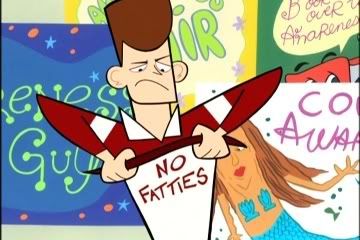
Its mighty difficult not to get fat over the holidays with all the eating, drinking, sleeping, and lounging around. It wold be interesting to know the aggregate total, in the United States, of all pounds gained during this week.
Monday, December 25, 2006

wassail \WAH-sul; wah-SAYL\, noun:
1. An expression of good wishes on a festive occasion, especially in drinking to someone.
2. An occasion on which such good wishes are expressed in drinking; a drinking bout; a carouse.
3. The liquor used for a wassail; especially, a beverage formerly much used in England at Christmas and other festivals, made of ale (or wine) flavored with spices, sugar, toast, roasted apples, etc.
4. Of or pertaining to wassail, or to a wassail; convivial; as, a wassail bowl.
5. To drink to the health of; a toast.
6. To drink a wassail.
Christmas often means plum pudding, fruitcake, roast goose and wassail.
-- Florence Fabricant, "Recipes to Summon the Holiday Spirit", New York Times, December 21, 1988But have you ever tried to spear a buffalo after a hard night at theold wassail bowl?
-- Gore Vidal, The Smithsonian Institution
Some Christmas Cheer

I posted this last Christmas and think that it deserves a re-posting. Below is a fine recipe for delicious eggnog which may be enjoyed during this time of the year.
6 Large eggs
3/4 c Sugar
1 1/2 c Brandy
1/2 c Rum
4 c Milk
4 c Cream
1/2 c Icing sugar
Nutmeg to sprinkle
Separate the yolks from the whites of the eggs. Beat the yolks slowly while simultaneously adding the sugar; do this until the mixture is pale and golden. Now slowly add in the brandy and rum, then beat in the milk and half the cream.
Set aside until just before serving, then whisk the egg whites until stiff and fold them into the eggnog mixture. Whip the remaining cream and icing sugar until thick. Top each glass of eggnog with whipped cream and a shake of nutmeg. This yields eight servings.
Saturday, December 23, 2006
Second Life

I just received an interesting e-mail concerning Second Life. Many of you all may have heard of this, but many of you probably have not. I had only been vaguely aware of this new internet phenomenon. For those of you who do not know, Second Life is one of several virtual worlds, and is probably the most successful. It first went online in 2003 and is modeled after the "metaverse." The metaverse is where computerized avatars--digital characters constructed to (usually) look like humans--interact. They buy and sell real estate, goods and services to each other; conduct classes; and give live entertainment concerts.
Second Life welcomed its one millionth resident in September of this year. Last week its residents topped 2,000,000. Three years to get the first million, then doubling in three months. That gives you some idea of its momentum
There is also an active currency exchange. Second Life's currency is the "Linden." (Linden Labs owns and operates Second Life.) The current rate of exchanges is approximately 270 Lindens to $1US. I have been discussing the viability of purchasing Lindens as an alternative investment.
Harvard Law School is teaching a class that can only be attended via Second Life, and IBM bought a massive piece of real estate where they built a 200 seat auditorium to house company meetings.
It will be very interesting to follow the evolution of Second Life, and see if it will be as prevalent in our culture as Google, YouTube, and Amazon.com.
Thursday, December 21, 2006
Merry Christmas

This photo was taken of downtown Maysville, KY, and brings thoughts of small town Americana to mind.
Tuesday, December 19, 2006
dictum \DIK-tuhm\, noun:
1. An authoritative statement; a formal pronouncement.
2. Law) A judicial opinion expressed by judges on points that do not necessarily arise in the case, and are not involved in it.
I have taken to heart Francis Bacon's dictum that "truth emerges more readily from error than from confusion".
-- Donald B. Calne, Within Reason: Rationality and Human Behavior
Monday, December 18, 2006
The Daily Cartoon
This post is to let you know that at the very bottom of this blog, I have a cartoon, which changes daily, thanks to the folks at NewsBusters. Chances are many of you will hate the cartoons, many of you will like them, but in any case, I hope you find them interesting and perhaps a little thought provoking.
Sunday, December 17, 2006
Investment Banking Blog
Here is a blog of a student who is trying to break into Investment Banking. He chronicles the entire interview process (applications, phone interviews, oft-asked questions, etc) and I think its a pretty interesting read.
Here is the tagline:
I am a student at the University of Denver's Daniels College of Business. I am a Master of Science in Finance Candidate at Daniels College of Business at the University of Denver. My goal is to get a job in NYC in Investment Banking and help others who didn't go to a Top 10 school do the same. Can you help?
-Update-
If that interests you, here is another guy, this one from the University of Alabama, chronicling his efforts to make it to Wall Street.
Here is the tagline:
I am a student at the University of Denver's Daniels College of Business. I am a Master of Science in Finance Candidate at Daniels College of Business at the University of Denver. My goal is to get a job in NYC in Investment Banking and help others who didn't go to a Top 10 school do the same. Can you help?
-Update-
If that interests you, here is another guy, this one from the University of Alabama, chronicling his efforts to make it to Wall Street.
Saturday, December 16, 2006
Koreans Deal Poorly with Leisure

I came across an article in the WSJ several months ago and thought it was very interesting. The title is "More Play, Less Toil Is a Stressful Shift For Some Koreans." The article focuses on the fact that South Korea has been scaling their traditional work week back to five days, and "even though they are paid the same wages to work fewer hours, many Koreans are still unsettled by the prospect of having more free time." Many people are having difficulty filling up their free time. The problem is such that there are now "leisure counselors" who instruct the Koreans on how to relax for that whole extra day.
If someone gave me an extra day of weekends, I don't think I would have a problem.
Thursday, December 14, 2006
World's Tallest Man Saves Dolphins
I have received numerous e-mails about this story, and upon reading, feel that it certainly deserves a post on The Mint Julep. Below are pictures of the tallest man in the world (7'9") saving two dolphins by pulling pieces of plastic out of their stomachs with his 41 inch arms. You can read several stories about this here, here, and here.


Wednesday, December 13, 2006
Monday, November 27, 2006
Word of the Day
mollify \MOL-uh-fy\, transitive verb:
1. To pacify; to soothe or calm in temper or disposition.
2. To reduce in intensity; to temper.
3. To soften; to reduce the rigidity of.
One hundred seventeen and a half pesos! Did you think you could mollify me with that amount, Philip V?
-- Ana Teresa Torres, Doña Inés vs. Oblivion
1. To pacify; to soothe or calm in temper or disposition.
2. To reduce in intensity; to temper.
3. To soften; to reduce the rigidity of.
One hundred seventeen and a half pesos! Did you think you could mollify me with that amount, Philip V?
-- Ana Teresa Torres, Doña Inés vs. Oblivion
Friday, November 17, 2006
Rutger - BCS Discussion
Here is an interesting discussion from Pro-football-reference concerning the controversy which will ensure if Rutgers finishes out the season undefeated, but does is not selected to play in the championship game.
If Rutgers is undefeated and does not play in the title game, will that be because of Big East bias, or will it be because of preseason poll bias?
Every reputable ranking system I’ve seen (here are a few: I, II, III) say that the Big East is stronger than the Big XII and the ACC. So the question is, if Missouri or Texas A&M or Wake Forest had gone undefeated this year, would they be getting the same treatment Rutgers is now getting? If yes, then it’s preseason bias (and/or reputation bias). If no, then it’s Big East bias.
I don’t have any evidence to back this up, but I happen to think that it’s yes. The problem isn’t that people are undervaluing the Big East. It’s that people, even at the end of the season, haven’t phased their preseason expectations out of their internal ranking algorithms.
If Rutgers is undefeated and does not play in the title game, will that be because of Big East bias, or will it be because of preseason poll bias?
Every reputable ranking system I’ve seen (here are a few: I, II, III) say that the Big East is stronger than the Big XII and the ACC. So the question is, if Missouri or Texas A&M or Wake Forest had gone undefeated this year, would they be getting the same treatment Rutgers is now getting? If yes, then it’s preseason bias (and/or reputation bias). If no, then it’s Big East bias.
I don’t have any evidence to back this up, but I happen to think that it’s yes. The problem isn’t that people are undervaluing the Big East. It’s that people, even at the end of the season, haven’t phased their preseason expectations out of their internal ranking algorithms.
Thursday, November 16, 2006
RIP Milton Friedman

Milton Friedman, the pro-capitalism and free market economic genius, who coined the phrase, "There is no such thing as a free lunch" died today. He was 94 years old. Here is a comprehensive article chronicling his life, and if you are even more interested, here you can find his memoirs, which he co-authored with his life. Friedman really was one of the last, great economists, and has been one of my personal favorites throughout my studies.
Friday, November 10, 2006
Starbucks Caffeine Inhaler
This delivers a grande sized burst of caffine with each blast while making your breath minty fresh.

Fortunately, I doubt this is real. However, for all you Starbucks lovers, you can read, here, about how Starbucks is going to devour your pocketbook, one $4.99 latte at a time.
Here is an excerpt:
What's more, Starbucks already has a reputation for having the most expensive coffee in the marketplace. When I left Moneybox's New York headquarters to conduct research at the closest Starbucks (a block away), I passed a half-dozen other coffee vendors. There's the guy with the cart who sells the little Greek diner cups for 50 cents; the deli with the scalding 75-cent generic joe and the thin paper cup; the convenience store with $1.00 faux gourmet stuff; and Cosi, where a latte costs $3.59. Only after running this gantlet could I enter Starbucks, where a java chip Frappuccino runs $4.75.

Fortunately, I doubt this is real. However, for all you Starbucks lovers, you can read, here, about how Starbucks is going to devour your pocketbook, one $4.99 latte at a time.
Here is an excerpt:
What's more, Starbucks already has a reputation for having the most expensive coffee in the marketplace. When I left Moneybox's New York headquarters to conduct research at the closest Starbucks (a block away), I passed a half-dozen other coffee vendors. There's the guy with the cart who sells the little Greek diner cups for 50 cents; the deli with the scalding 75-cent generic joe and the thin paper cup; the convenience store with $1.00 faux gourmet stuff; and Cosi, where a latte costs $3.59. Only after running this gantlet could I enter Starbucks, where a java chip Frappuccino runs $4.75.
Global Forces
Per Michael Mandel with BusinessWeek:
Sometime next year—perhaps around Christmas 2007, if current trends continue—the U.S. will hit a milestone. For the first time in recent memory, the cost of imported goods and services will exceed federal revenues. In other words, Americans will soon pay more to foreigners than they do to their national government.
We're almost there now. Imports cost us about $2.2 trillion a year; the federal government collects $2.4 trillion in revenues. Why is that important? Because for the past 70 years, Washington has been the 800-pound gorilla, more powerful by far than any other force in the U.S. economy. That's not true anymore. The federal government remains plenty influential, but the global economy is more so.
This will come as a rude shock to Representative Nancy Pelosi (D-Calif.), the presumptive Speaker of the House, Charles B. Rangel (D-N.Y.), the likely chairman of the House Ways & Means Committee, and other newly enfranchised leaders in the Democratic Party. Sure, they're likely to have the power to pass legislation, including boosting the minimum wage. But such a measure, even if President George W. Bush signed it, would help only a small fraction of the workforce. It would do almost nothing to ameliorate the weak wage growth that has plagued most Americans, including college graduates, in recent years. The broad-based drop in incomes is being driven more by the rise of China and India and the intensification of global competition. And there is little Democrats can do to reverse these trends.
I am as big a fan of free trade as anyone, yet it does frighten me the way those guys in Bangalore, India, and China are eating into the U.S. Economy. My take on it, is that it will force Americans to get off their fats and start learning. While our labor costs cannot compete with India, we can at least make a push at educating ourselves to the degree of those phenomenal Indian technical institutes.
When it comes down to it, Americans lack drive. The Indians are hungry, and will do what it takes to work there way into a decent lifestyle, while Americans, in general, are fat, lazy, and complacent to watch Grey's Anatomy and Lost every night. My message is this: Wake up everyone, or we will all find ourselves being eaten for lunch by the rest of the hungry world.
Tuesday, November 07, 2006
Wal-Mart Economics
This is per Arnold Kling over at EconLog:
At the MIT economics alumni event this morning, Jerry Hausman spoke about his research on Wal-Mart. He says that Wal-Mart lowers prices to consumers primarily by bargaining down the prices charged by suppliers, such as Procter and Gamble. It also uses cost-saving logistics. Lower labor costs may contribute to its low prices, but not as much as the other factors.
Hausman argues that driving down prices of suppliers is a benefit, because prices are being driven closer to marginal cost. In welfare-economics terms, you can think of Wal-Mart as a substitute for a regulator who would try to improve efficiency by forcing imperfectly competitive producers to move down the demand curve.
The magnitude of the benefit is enormous. Hausman looked at food, and for that category alone Wal-Mart increases consumer welfare by 25 percent (I'm a bit worried that the theory behind his calculations holds only for much smaller differences, but I don't have an alternative.) Since food is about 12 percent of GDP, multiplying .25 by .12 gives a benefit of .03, or 3 percent of GDP from Wal-Mart.
Saturday, November 04, 2006


Wednesday, November 01, 2006
Word of the Day
prevaricate \prih-VAIR-uh-kayt\, intransitive verb:
To depart from or evade the truth; to speak with equivocation.
Journalism has a similar obligation, particularly with men and women suddenly transferred to places of great power, who are often led to exaggerate and prevaricate, all in the name of a supposedly greater good.
-- Stephen R. Graubard, "Presidents: The Power and the Mediocrity", New York Times, January 15, 1989
To depart from or evade the truth; to speak with equivocation.
Journalism has a similar obligation, particularly with men and women suddenly transferred to places of great power, who are often led to exaggerate and prevaricate, all in the name of a supposedly greater good.
-- Stephen R. Graubard, "Presidents: The Power and the Mediocrity", New York Times, January 15, 1989
Subscribe to:
Posts (Atom)


