Thursday, November 20, 2008
Marvin Gaye - I Heard It Through The Grapevine (a capella)
And another version - this time with full instrumental.

Friday, October 03, 2008
Tuesday, September 30, 2008

Wednesday, September 24, 2008
Michael Lewis, author of Liar's Poker, gives five positives that have come out of the current financial crisis. An excerpt:
Our willingness to believe that we can hire some expert to tell us how to outperform markets is a big problem, with big consequences. It underpins Wall Street's brokerage operations, for instance, and leads to a lot more people giving out financial advice than should be giving out financial advice.
Thanks to the current panic many Americans have learned that the experts who advise them what to do with their savings are, at best, fools. Merrill Lynch & Co., Morgan Stanley, and all the rest persuaded their most valuable customers to buy auction-rate bonds, telling them the securities were as good as cash.
Those customers will now think twice before they listen to their brokers ever again.
Many, I'm sure, are just waiting to get their money back from their brokers before they race for the exits and introduce themselves to Charles Schwab.
Here is the full article.
Our willingness to believe that we can hire some expert to tell us how to outperform markets is a big problem, with big consequences. It underpins Wall Street's brokerage operations, for instance, and leads to a lot more people giving out financial advice than should be giving out financial advice.
Thanks to the current panic many Americans have learned that the experts who advise them what to do with their savings are, at best, fools. Merrill Lynch & Co., Morgan Stanley, and all the rest persuaded their most valuable customers to buy auction-rate bonds, telling them the securities were as good as cash.
Those customers will now think twice before they listen to their brokers ever again.
Many, I'm sure, are just waiting to get their money back from their brokers before they race for the exits and introduce themselves to Charles Schwab.
Here is the full article.
Monday, September 22, 2008
Friday, September 12, 2008
"I believe in Sewanee with all my heart. I do not know of any institution of its size in any part of our country which has done more for the cause of good citizenship than Sewanee has done. As an American I am proud of it; as a citizen I am grateful to it. It is entitled The University of the South, but it is much more than that; it is a University of all America, and its welfare should be dear to all Americans who are patriotic and farsighted, and therefore anxious to see every influence strengthened which tends for the betterment and enlightenment of our great common country."
— President Theodore Roosevelt, June 4, 1907
— President Theodore Roosevelt, June 4, 1907
Tuesday, September 09, 2008
Russia/Georgia Conflict Debunks McDonald's Theory of War
Excerpt below from the article here at The Guardian.
The logic is thus: countries with middle classes large enough to sustain a McDonald's have reached a level of prosperity and global integration that makes warmongering risky and unpalatable to its people.
The Russia-Georgia conflict has finally blown this theory out of the water.
Thomas Friedman, who invented the theory in 1996, said people in McDonald's countries "don't like to fight wars. They like to wait in line for burgers."
Wednesday, September 03, 2008
Sunday, August 31, 2008
Saturday, August 30, 2008

redress \rih-DRES\, transitive verb:
1. To put in order again; to set right; to emend; to revise.
2. To set right, as a wrong; to repair, as an injury; to make amends for; to remedy; to relieve from.
3. To make amends or compensation to; to relieve of anything unjust or oppressive; to bestow relief upon.
Before adjourning in October 1774, the First Continental Congress called for the convening of another congress at Philadelphia on May 10, 1775, only if Britain had not redressed the Americans' grievances.
-- Pauline Maier, American Scripture :Making the Declaration of Independence
Saturday, August 23, 2008
Scott Russell Sanders:
There is a mystical virtue in right angles. There is an unspoken morality in seeking the level and the plumb. A house will stand, a table will bear weight, the sides of a box will hold together only if the joints are square and the members upright.
When the bubble is lined up between two marks etched in the glass tube of the level, you have aligned yourself with the forces that hold the universe together.
- The Paradise of Bombs
There is a mystical virtue in right angles. There is an unspoken morality in seeking the level and the plumb. A house will stand, a table will bear weight, the sides of a box will hold together only if the joints are square and the members upright.
When the bubble is lined up between two marks etched in the glass tube of the level, you have aligned yourself with the forces that hold the universe together.
- The Paradise of Bombs
Sunday, August 17, 2008
Phelps 100 Meter Fly Photo Finish

Also, Sports Illustrated has a very good frame-by-frame sequence of pictures that show the finish.
Also of interested is this article on how Omega, the official timekeeper of the Olympics, keeps time in the Water Cube. Here's a neat excerpt:
OMEGA touch pads and starting blocks are part of an integrated timing system capable of recording times to the nearest 1/1000th of a second. However, because it is not possible to build swimming pools in which each lane is guaranteed to be precisely the same length, Olympic and World Records are still recorded to the nearest 1/100th of a second.
Tuesday, August 12, 2008
List of Common Misconceptions
Per one of my favorite web resources, Wikipedia. Here are a few examples:
1. Christopher Columbus's efforts to obtain support for his voyages were not hampered by a European belief in a flat Earth.[3] In fact, sailors and navigators of the time knew that the Earth was spherical, but (correctly) disagreed with Columbus' estimates of the distance to the Indies (see Flat Earth). If the Americas did not exist, and Columbus had continued to the Indies (even putting aside the threat of mutiny he was under) he would have run out of supplies before reaching them at the rate he was traveling.
2. The Coriolis effect does not determine the direction that water rotates in a bathtub drain or a flushing toilet. The Coriolis force is relatively small; it appears over large scales (like weather systems) or in systems such as the Foucault pendulum in which the small influence is allowed to accumulate over time. In a bathtub or toilet, the flow of the water over the basin itself produces forces that dwarf the Coriolis force. In addition, most toilets inject water into the bowl at an angle, causing a spin too fast to be affected by the Coriolis effect.[33]
1. Christopher Columbus's efforts to obtain support for his voyages were not hampered by a European belief in a flat Earth.[3] In fact, sailors and navigators of the time knew that the Earth was spherical, but (correctly) disagreed with Columbus' estimates of the distance to the Indies (see Flat Earth). If the Americas did not exist, and Columbus had continued to the Indies (even putting aside the threat of mutiny he was under) he would have run out of supplies before reaching them at the rate he was traveling.
2. The Coriolis effect does not determine the direction that water rotates in a bathtub drain or a flushing toilet. The Coriolis force is relatively small; it appears over large scales (like weather systems) or in systems such as the Foucault pendulum in which the small influence is allowed to accumulate over time. In a bathtub or toilet, the flow of the water over the basin itself produces forces that dwarf the Coriolis force. In addition, most toilets inject water into the bowl at an angle, causing a spin too fast to be affected by the Coriolis effect.[33]
Monday, August 11, 2008
Monday, August 04, 2008

Friday, July 25, 2008
The Process
What if there were no stop signs... and a major corporation was charged with inventing one?
Pretty humorous commentary on marketing these days.
Pretty humorous commentary on marketing these days.
Wednesday, July 23, 2008
What can $5 buy?
A website which shows pictures of all kinds of thing in the world that cost $5.00. They call it The Five Dollar Comparison.
To explore the relative value of five dollars we are collecting examples from around the world by asking people to submit photos of objects or services that cost the equivalent of $5.
To explore the relative value of five dollars we are collecting examples from around the world by asking people to submit photos of objects or services that cost the equivalent of $5.
Sunday, July 13, 2008
Tuesday, July 08, 2008
How the Rich Would Fare Under Obama, McCain
This is all straight from the WSJ. The last paragraph is especially instructive.

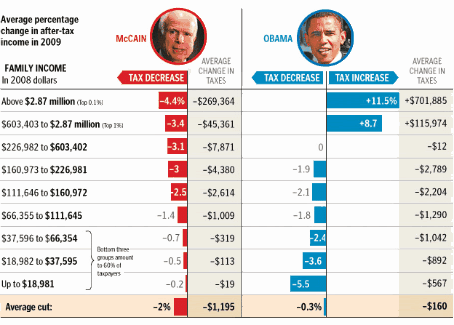
There’s a lot confusing information out there about how the next president will tax the rich. But one chart boils it all down. It comes courtesy of the Tax Policy Institute and I’ve reproduced it below. It shows the average percentage change in after-tax income for various groups in 2009. The blue bar is Barack Obama and the red bar is John McCain.
Not surprisingly, Mr. Obama’s plan helps those at the bottom of the wealth ladder while Mr. McCain’s plan helps those at the top. What’s most striking, however, is the divergence in incomes for the truly wealthy — the top 1% and the top tenth of 1%.
Under Mr. Obama’s plan, the income for the top 1% would decline by an average of 9%. The incomes of the top tenth of 1% would shrink by more than 10%. Under Mr. McCain, incomes for the top 1% would grow by 3%. The top tenth of 1% do best — with more than 4% growth in incomes.
The estate-tax differences are also stark. Both candidates plan to increase the estate-tax exemption, and would also reduce the rate as it’s now scheduled through 2010. Yet Mr. McCain would raise the exemption and lower the rate more. The impact: 8.8 million Americans in 2009 would file estate-tax returns under Mr. McCain, while 15.5 million would file under Mr. Obama’s plan. Mr. McCain’s plan would collect $4.2 billion in estate taxes, while Mr. Obama’s plan would collect $17.9 billion.
It’s unlikely either plan will be implemented as is. But one thing is clear: Mr. Obama sees taxes as a way to ease inequality, while Mr. McCain sees them as a way to encourage economic growth by helping the top.

Subscribe to:
Posts (Atom)


